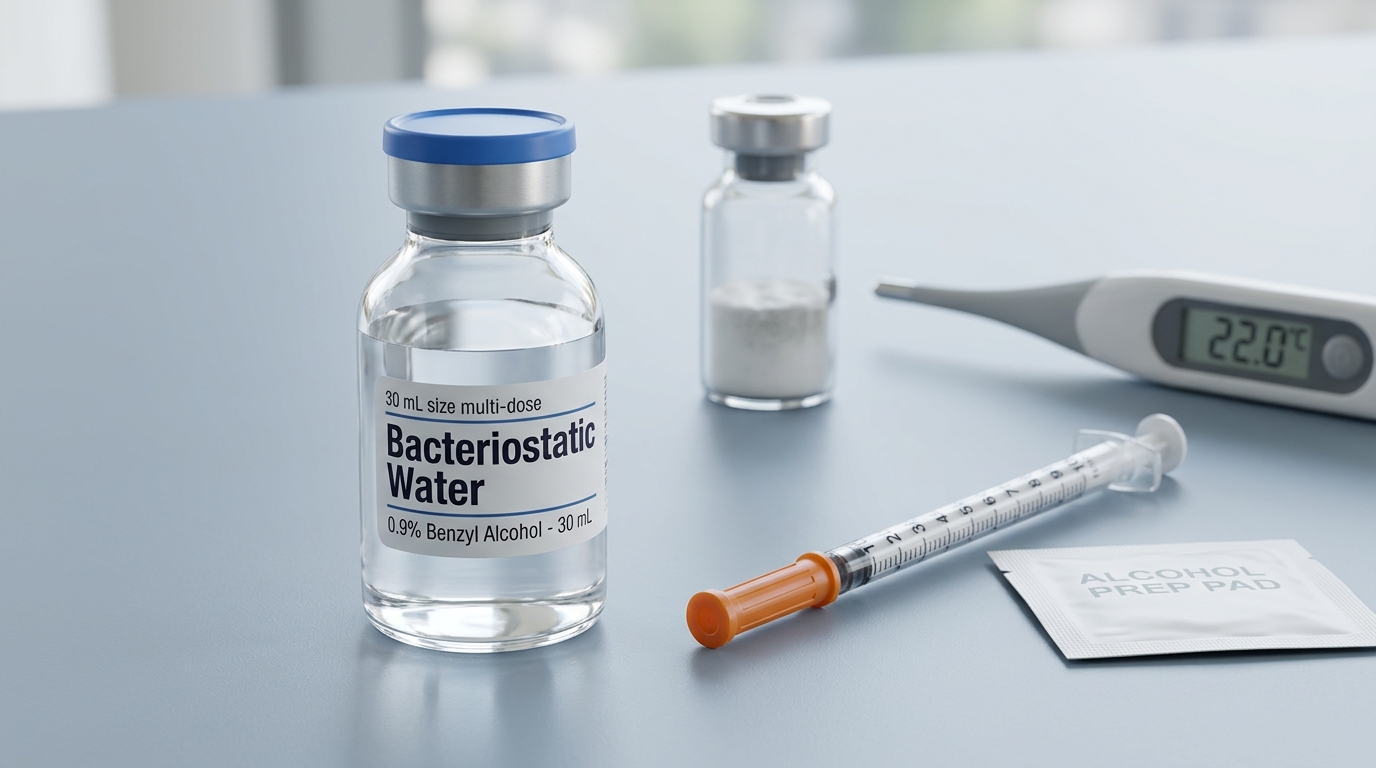
The Short Answer
According to official USP <797> clinical standards, opened bacteriostatic water should be discarded 28 days after the first needle puncture. Unopened vials remain stable until the manufacturer’s printed expiration date (typically 2 to 3 years). Crucially, bacteriostatic water should be stored at controlled room temperature (20°C–25°C / 68°F–77°F) in a dark cabinet—not in the refrigerator.
Why Does the 28-Day Rule Exist?
Unlike plain sterile water—which has zero preservatives and must be discarded immediately after a single use—bacteriostatic (BAC) water contains 0.9% benzyl alcohol. This antimicrobial preservative does not kill every microbe on contact, but it prevents bacteria from multiplying inside the multi-dose vial. (For a deeper look at the chemistry, read our guide on Bacteriostatic Water vs. Sterile Water.)
So why does the United States Pharmacopeia (USP) enforce a strict 28-day Beyond-Use Date (BUD) once the rubber stopper is pierced? Two practical reasons:
- Repeated Stopper Punctures (Coring): Every time a needle pierces the butyl rubber stopper, it introduces ambient air and microscopic contaminants while slightly degrading the self-sealing membrane. Over weeks of repeated draws, the rubber loses its tight seal.
- Conservative Clinical Safety Margins: The 28-day standard was written for busy hospitals and clinics where dozens of nurses draw from the same multi-dose vial. In that high-traffic environment, 28 days guarantees antimicrobial efficacy even under imperfect handling.
The Reality Check: 28 Days vs. Real-World Lab Practice
Because standard pharmaceutical vials (such as Hospira 30mL BAC water) hold far more liquid than most single-peptide protocols require, researchers frequently debate whether tossing a 90%-full bottle on day 29 is strictly necessary.
Chemically, 0.9% benzyl alcohol does not suddenly evaporate or deactivate at midnight on day 28. However, bacterial contamination is invisible to the naked eye until it reaches dangerous levels. When you are reconstituting peptides that will subsequently sit in your fridge for another 30 days (see our Reconstituted Peptide Fridge Shelf-Life Guide), starting with compromised solvent compounds your risk.
The smart rule of thumb: Bacteriostatic water is inexpensive compared to high-purity peptides or dealing with a painful injection-site infection. Write the date of first puncture directly on the vial label with a permanent marker, follow the 28-day clinical standard whenever possible, and never stretch a punctured vial that has been pierced repeatedly or handled without strict aseptic technique.
Should You Refrigerate Bacteriostatic Water?
This is one of the biggest misconceptions in the peptide community. Many beginners instinctively put their BAC water in the refrigerator right next to their mixed peptides. Pharmaceutical manufacturers explicitly advise against refrigerating bacteriostatic water.
- Official Storage Temperature: Major manufacturers like Pfizer/Hospira specify controlled room temperature—20°C to 25°C (68°F to 77°F)—protected from direct UV light.
- Why Cold Storage Can Backfire: Lowering the temperature reduces the solubility of benzyl alcohol in water, which can theoretically cause micro-separation or pH drift over time. Additionally, moving a cold bottle in and out of the fridge creates condensation around the rubber stopper, increasing contamination risk.
- Simple Rule to Remember: Reconstituted peptides go in the fridge (2°C–8°C). Unmixed bacteriostatic water stays in a cool, dark cabinet at room temperature.
5 Signs You Must Throw Away Your Bacteriostatic Water Immediately
Even if your vial is well within the 28-day window, discard it immediately and open a fresh bottle if you notice any of the following red flags:
- Cloudiness or Floating Particles: BAC water must be 100% crystal clear. Any haze, sediment, or floating specks indicates bacterial growth or rubber stopper coring.
- Rubber Stopper Damage: If the gray rubber stopper is visibly torn, leaking when inverted, or has a chunk missing from using too large a gauge needle.
- Needle Cross-Contamination: If you ever accidentally inserted a syringe that already touched skin, a peptide vial, or a non-sterile surface back into the BAC water bottle.
- Frozen or Overheated Vial: If the bottle accidentally froze solid or sat in a hot car above 30°C (86°F) for an extended period.
- Past the Printed Expiration Date: Unopened vials last 2–3 years, but once past the manufacturer’s expiration date, benzyl alcohol concentration and glass leachables are no longer guaranteed.
How to Maximize Sterility Every Time You Draw
To keep your bacteriostatic water pristine throughout its 28-day active window:
- Swab Every Single Time: Wipe the rubber stopper vigorously with a fresh 70% isopropyl alcohol pad and let it air-dry for 10 seconds before piercing.
- Use a Fresh, Sterile Syringe: Never double-dip. Use a brand-new syringe solely to draw your diluent volume. Not sure how much to draw? Check our How Much Bacteriostatic Water to Add Guide or run your exact numbers in our Universal Peptide Dosage Calculator.
- Don’t Pre-Mix Extra Peptide Vials: Never reconstitute extra lyophilized peptide vials just to "use up" remaining BAC water before day 28. Dry peptide powder stays stable in the freezer for years, whereas liquid peptides begin degrading immediately.
Conclusion
Keep your bacteriostatic water simple: store it in a cool, dark cabinet at room temperature (never the fridge), mark the date of your first puncture on the label, swab the stopper before every draw, and replace the vial after 28 days. Good diluent hygiene is the cheapest insurance policy in peptide research.