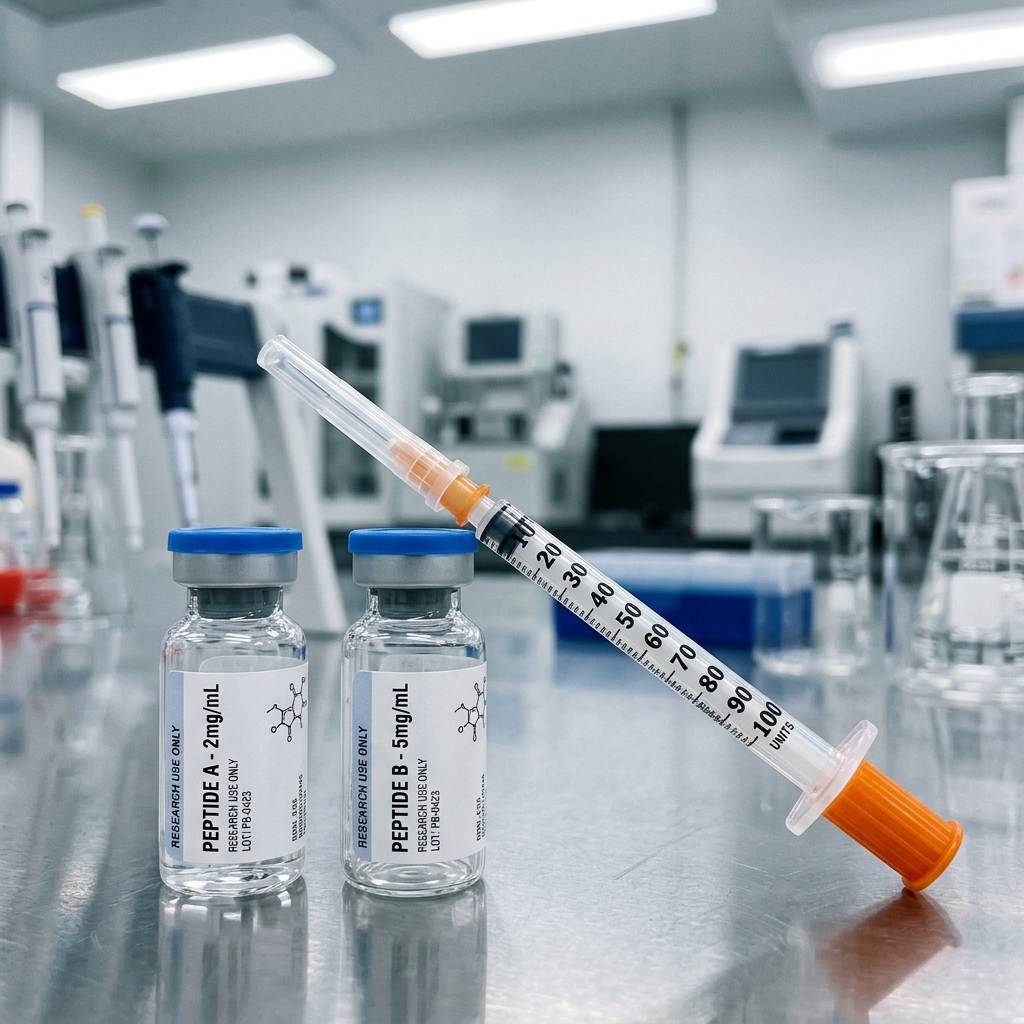
The Quick Answer
Yes, you can mix compatible peptides in the same syringe. The most common stack, BPC-157 and TB-500, can absolutely be drawn into a single U-100 syringe. However, you must execute the Sequential Draw Technique to prevent vial contamination, and the peptides must share the same bacteriostatic solvent matrix and pH compatibility.
The Problem: Puncture Fatigue
When conducting research involving multi-compound protocols (e.g., healing stacks or anti-aging stacks like CJC-1295 / Ipamorelin), the necessity of multiple separate administrations rapidly leads to puncture fatigue, tissue scarring, and decreased protocol compliance. Combining solutions into a single mechanical syringe draw mitigates this issue entirely.
However, novice researchers often attempt to mix peptides directly in the same glass vial, or they draw from two vials improperly, causing the vacuum pressure of one vial to suck the foreign peptide into its sterile environment.
Step-by-Step: The Sequential Draw Protocol
To safely combine two peptides (e.g., Peptide A and Peptide B) into one syringe without cross-contamination, strict atmospheric pressure management is required.
Standard Operating Procedure (SOP)
- 1
Calculate Both Doses
Determine the required U-100 tick marks for both peptides. For example, if Peptide A requires 10 Units and Peptide B requires 15 Units, your total syringe volume will be 25 Units.
- 2
Pressurize Both Vials
Before drawing any liquid, pull 10 units of air into the syringe and inject it into Vial A. Remove the needle. Then, pull 15 units of air and inject it into Vial B. This neutralizes the vacuum.
- 3
Draw Peptide A
Leave the needle in Vial B (or re-insert into Vial A depending on preference). Draw exactly 10 Units of Peptide A. Remove the syringe.
- 4
Draw Peptide B (The Critical Step)
Insert the needle into Vial B. Do not push the plunger down, as this will inject Peptide A into Vial B's sterile environment. Because you already pressurized the vial with air, the liquid will naturally want to enter the syringe. Slowly pull the plunger back from 10 Units to the 25 Unit mark. Remove the syringe.
The Science of Mixing: pH and Compatibility
While the mechanical extraction is straightforward, the chemistry of the peptides dictates whether they can share a liquid matrix.
The pH Compatibility Rule
Peptides are highly sensitive to pH environments. If you mix an acidic peptide with a basic peptide, immediate degradation and precipitation (cloudiness) will occur.
- Compatible Stacks: BPC-157 & TB-500. Both are highly stable in neutral bacteriostatic water environments and do not compete for cellular receptors. Similarly, CJC-1295 & Ipamorelin are universally compatible.
- Incompatible Stacks: Peptides like IGF-1 LR3 require acetic acid for stability. Mixing an acetic acid-reconstituted peptide with a BAC water-reconstituted peptide in the same syringe will alter the pH and destroy the fragile amino acid bonds within minutes.
Critical Warning: Vial Mixing
Never reconstitute two different lyophilized peptide pucks into the same glass vial (e.g., injecting liquid BPC-157 into a TB-500 vial). Once mixed in a single vial, the long-term degradation kinetics become entirely unpredictable, and the solution will likely crash out of suspension within 48 hours. Only mix them temporarily inside the syringe immediately prior to administration.
Conclusion
Consolidating administrations by mixing peptides in a single syringe is an accepted and efficient standard in laboratory protocols. By mastering the Sequential Draw Technique, you maintain absolute sterility of your primary vials while ensuring accurate volumetric extraction.
Need Certified Research Peptides or Reconstitution Solvents?

Dr. Peter Attia
MDFounder, Early Medical | Host, The Drive Podcast
Dr. Peter Attia is a physician focusing on the applied science of longevity. His practice deals extensively with nutritional interventions, exercise physiology, sleep physiology, emotional and mental health, and pharmacology to increase lifespan (how long you live) and healthspan (how well you live).