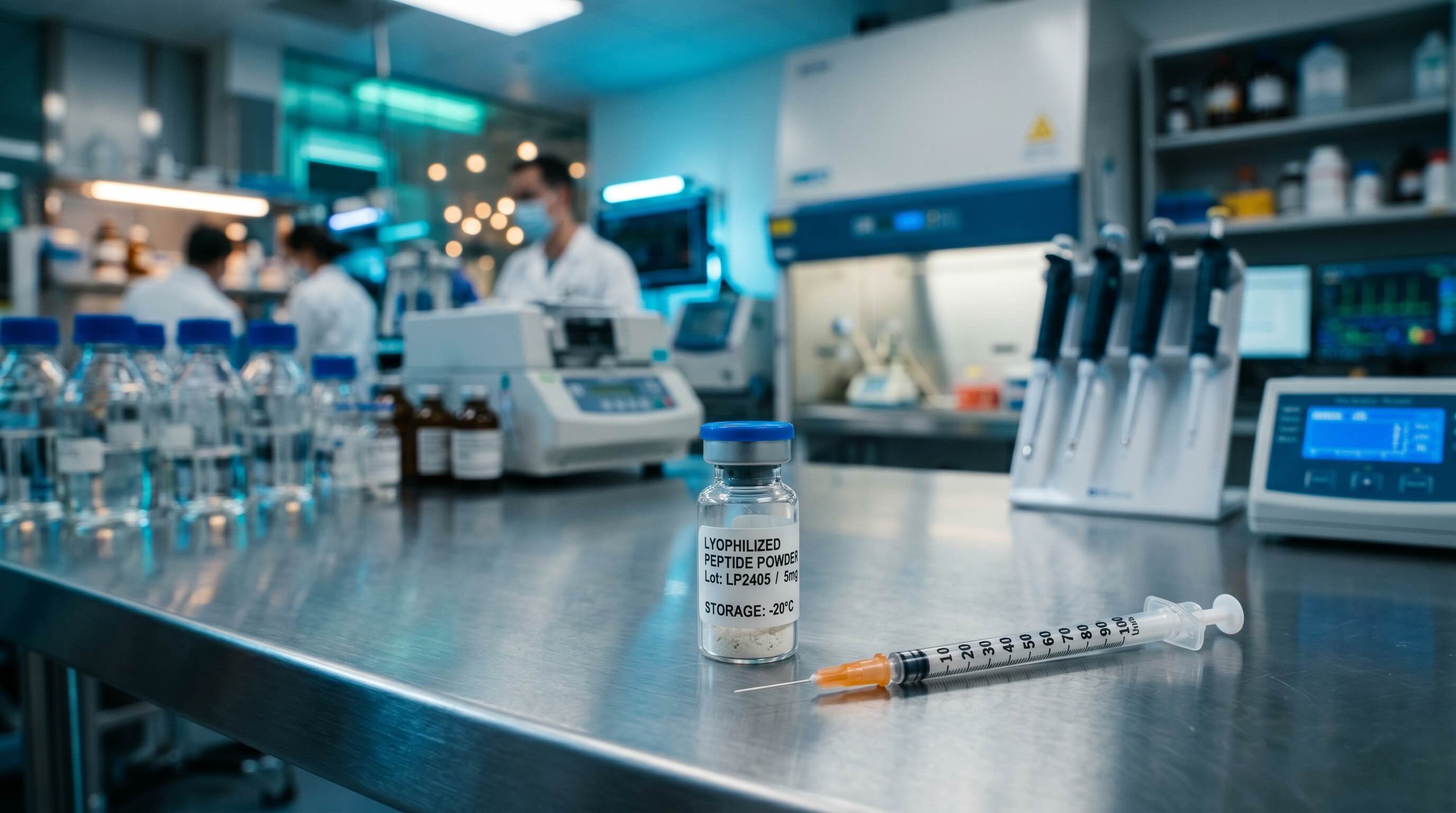
Introduction: The Imperative of Mathematical Rigor
In the domain of modern biochemistry and synthetic endocrinology, visual estimation is the adversary of precision. Lyophilized peptides—whether they are massive 43-amino acid sequences like Thymosin Beta-4 or robust 15-amino acid chains like BPC-157—are distributed in absolute dry mass metrics (milligrams). However, physiological systems do not process dry mass; they process suspended saturated fluids. Bridging the gap between a vacuum-sealed lyophilized compound and a bio-active suspended vector requires strict adherence to mathematical constants.
The failure to accurately map the required dilution matrix directly results in protocol failure. Extreme dosing drifts yield either severe localized toxicity or absolute sub-clinical null efficacy. This technical manual establishes the Standard Operating Procedure (SOP) for utilizing the underlying algebraic functions of a professional Peptide Dosage Calculator to ensure laboratory-grade reconstitution.
Section 1: The Universal Algebra of Volumetric Extraction
The fundamental engine powering any highly optimized Peptide Dosage Calculator relies on a singular, unified algebraic mapping. The extraction volume () dictates the exact physical space inside a U-100 syringe barrel required to capture the target dose ().
To determine this, we must first compute the fluid density / molar concentration (), which is a function of the total raw lyophilized mass () divided by the total integrated solvent volume (). The isolated expression is:
Consequently, the master volumetric extraction formula deployed by clinical researchers simplifies to:
Let us define the operative variables:
- : The exact liquid volume to be extracted into the syringe (measured in milliliters or "Units").
- : The desired target dose in milligrams () or micrograms ().
- : The total un-hydrated mass in the primary vial (e.g., ).
- : The total injected volume of bacteriostatic water serving as the solvent base.
From Powder Identification to Volumetric Extraction
Every Peptide Dosage Calculator algorithm begins with empirical powder identification. Unlike macroscopic pharmaceuticals, synthetic polypeptides present as indistinguishable white crystalline pucks at the base of a vacuum-sealed vial. The volumetric footprint of the powder itself is considered mathematically negligible during fluid calibration.
When a researcher integrates Bacteriostatic Water (0.9% benzyl alcohol solvent), the peptide bonds undergo extreme osmotic hydration. The critical conceptual shift occurs here: Units are a measure of spatial geography, not molecular weight. A `1 Unit` designation on a U-100 syringe universally represents . The mass residing within that is fluid and entirely dependent on your input matrix.
Using a validated Peptide Dosage Calculator intercepts human mathematical assumptions and maps the exact mg-to-mcL ratio instantly.
Section 2: Plunger Parallax Error and Spatial Economics
The most corrosive force in clinical titration is Plunger Parallax Error (). Parallax error manifests when researchers inject a highly restricted volume of diluent (e.g., ) into a high-density mass (e.g., ).
At , the fluid matrix is hyper-condensed. If the protocol demands a biological transition of (), the resulting physical draw calculation dictates a spatial pull of only 5 Units ().
A 5-unit extraction on a standard barrel places the rubber plunger precariously close to the dead-space margin. Furthermore, visual misalignment of a single tick mark (1 Unit) results in a deviation in actual delivered mass. In endocrinology, a daily 20% systemic variance induces heavy plasma flux, stripping receptor sensitivity.
The Clinical Gold Standard: Elevating Solvent Volume
How do authoritative laboratory protocols neutralize Parallax Error? They deploy geometric expansion. By deliberately increasing the variable to or , you intentionally dilute the fluid density (), which mathematically broadens the physical required to capture the exact same un-altered dose ().
Revisiting the previous example using an expanded solvent baseline for the same payload target:
At a 15-Unit draw string, the margin of visual error is drastically compressed. A one-tick mechanical drift shifts the dosage by only rather than . The mass is perfectly preserved, but the mechanical delivery is vastly insulated against human error. Your peptide dosage calculator will instantly map these expanded volumetric ticks for you, rendering mental math obsolete.
SOP Output & Executive Summary
Never rely on static assumptions or generalized charts. A robust empirical protocol relies exclusively on recalculating density mappings via an interactive Peptide Dosage Calculator every time a new vial is instantiated. Scale your solvent arrays to to mitigate plunger parallax artifacts, lock your peptides in a thermal vault, and maintain absolute chronobiological dosing discipline.
By strictly adhering to these algebraic laws and implementing digital tooling, clinical researchers establish an ironclad foundation for reproducible, high-fidelity peptide titration tracking.