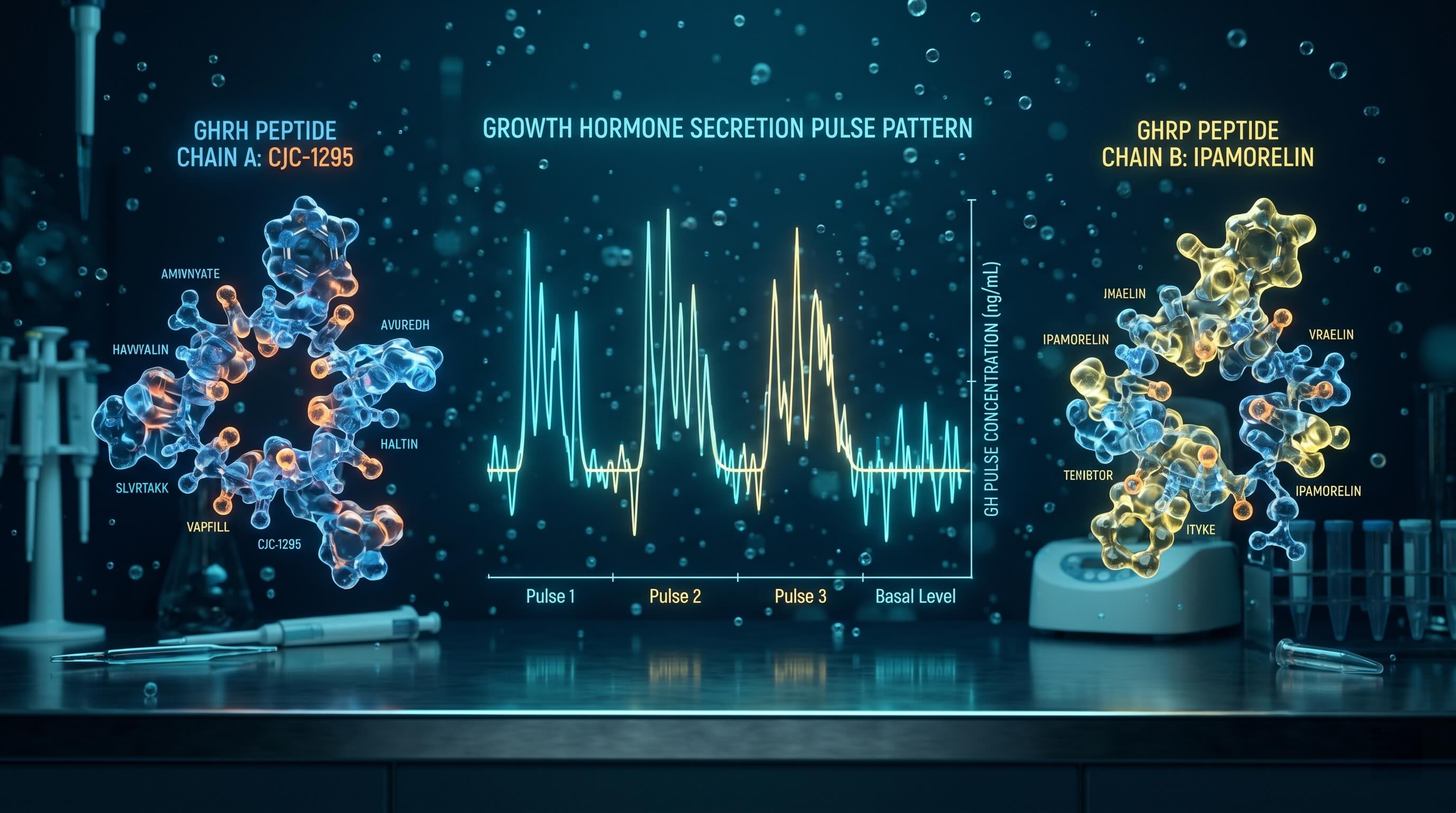
Introduction: The Somatotropic Axis
The Growth Hormone Releasing Peptide (GHRP) class represents a sophisticated lineage of synthetic hexapeptides specifically engineered to bypass traditional somatostatin blockades. Unlike endogenous Growth Hormone-Releasing Hormone (GHRH), which targets the somatotroph GHRH receptor, peptides like GHRP-6 and GHRP-2 function as highly selective synthetic agonists of the Growth Hormone Secretagogue Receptor 1a ().
This binding triggers an intense, pulse-mediated secretion of somatropin from the anterior pituitary gland. However, minor structural modifications between the hexapeptide chains yield profoundly distinct adverse effect profiles—most notably regarding ghrelin mimicry and hunger signaling. Accurate calibration requires rigorous math via an integrated GHRP 6 dosage calculator to prevent receptor desensitization over longitudinal research cycles.
Section 1: Molecular Architecture and GHS-R1a Binding Kinetics
Both GHRP-6 and GHRP-2 are structurally stabilized hexapeptides consisting of six amino acids protecting against proteolytic cleavage. Their primary mechanistic route involves docking onto the pathway, inducing a calcium ion () influx that overrides somatostatin (the natural inhibitory hormone).
- GHRP-6 (): The earliest successful first-generation ghrelin mimetic. While binding affinity is robust, it lacks absolute selectivity, resulting in mild downstream stimulation of both cortisol and prolactin.
- GHRP-2 (Pralmorelin): A second-generation iteration (). Structural tweaking increased the receptor binding affinity by approximately , yielding higher peak GH serum concentrations compared to GHRP-6 at equivalent microgram dosages.
Pharmacokinetic Note: To completely negate cortisol and prolactin elevations found in GHRP-6 and GHRP-2, modern laboratory protocols often substitute third-generation non-ghrelin secretagogues. Refer to our CJC-1295 & Ipamorelin Dosage Calculator for modeling pure synergistic GH pulses without hormonal spillover.
The Ghrelin Response: Hunger Signaling Variances
The starkest clinical divergence between GHRP-6 and GHRP-2 exists within the central nervous system's appetite regulation pathways. The receptor is intrinsically linked to the ghrelin hormone loop—endogenously responsible for signaling severe gastric emptiness to the hypothalamus.
GHRP-6 is notorious for extreme gastric stimulation. Upon subcutaneous administration, GHRP-6 violently accelerates gastric emptying and triggers acute, nearly uncontrollable acute hunger phases. This specific side-effect makes GHRP-6 highly prioritized in research models involving cachexia, wasting syndromes, or intentional hyper-caloric ingestion protocols.
Conversely, GHRP-2 provides significantly superior somatotropic pulsing amplitude but induces only mild to moderate hunger signals. From a purely endocrinological standpoint, GHRP-2 maximizes peak GH output while maintaining superior dietary compliance geometry in non-cachectic models.
Section 2: Titration Matrix and Half-Life () Dynamics
A foundational constraint of the GHRP family is extreme volatility in the bloodstream. Both GHRP-6 and GHRP-2 exhibit an incredibly rapid plasma half-life clearance of approximately:
This kinetic parameter dictates that chronological administration must be strictly regimented. Infrequent administration is bio-mechanically useless. Protocols demand daily administrations to continuously simulate biological pulsing. The mathematical "Ceiling Dose" (or Saturation Threshold) for both secretagogues rests heavily around the mark per injection.
Administrations exceeding in a single bolus trigger rigid diminishing returns and heavily increased cortisol response, providing negligible net-positive GH output. Utilizing an accurate GHRP 6 dosage calculator perfectly maps the syringe geometry to land precisely within this saturation pocket natively.
Synergistic Amplification (The "Stack" Protocol)
Because GHRP analogs (secretagogues) and GHRH analogs (releasing hormones) operate via vastly different receptor pathways on the anterior pituitary, combining them yields an amplified, synergistic neuro-endocrine event rather than an additive one.
If Compound X produces an output of , and Compound Y produces an output of , administering them concurrently yields an output volume of (metaphorically). The GHRP acts to unlock the cellular gate (inhibiting somatostatin), while the GHRH forces a massive GH cellular flush through that newly opened gate.
Laboratory Directives & Summary
Select GHRP-6 specifically when hyper-caloric food intake and gastric stimulation are the primary objectives of the research phase. Select GHRP-2 when absolute GH pulse amplitude is desired alongside mild dietary disruption. Both molecules mandate robust volumetric accuracy; leverage a GHRP 6 dosage calculator and a standardized biological-water dilution substrate to hit the extremely narrow saturation threshold reliably. To track these complex GHRP pulsing schedules synchronized across a multi-stage regimen, utilize our protocol management tool.