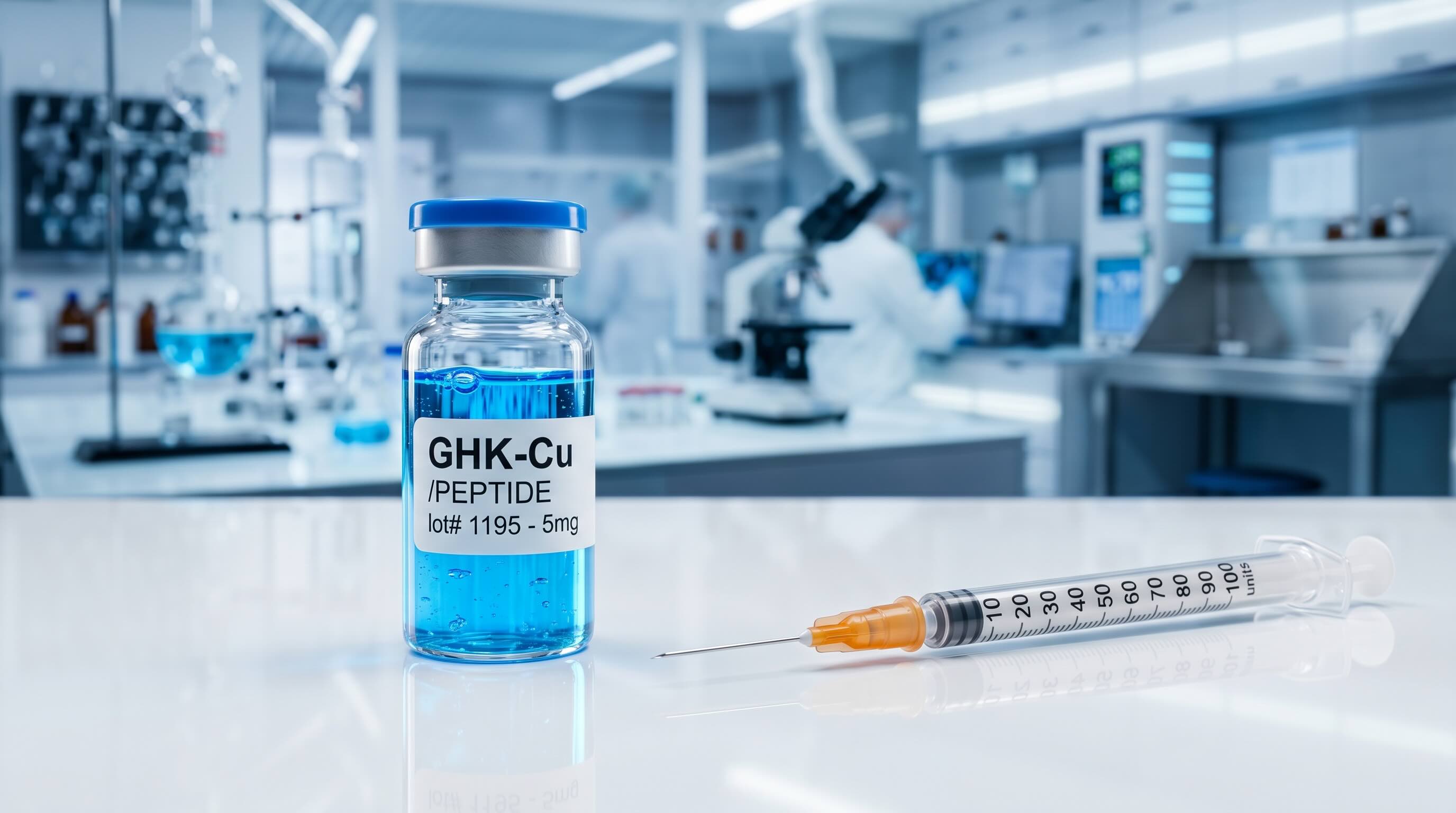
Introduction: The Glycyl-L-Histidyl-L-Lysine Complex
First isolated in 1973 from human plasma, the tripeptide GHK () possesses an exceptionally high naturally occurring binding affinity for divalent copper ions (). The biological fusion of these elements creates GHK-Cu, a deeply complex chelate operating as an absolute master-regulator of human tissue remodeling and cellular expression.
Unlike purely metabolic secretagogues, GHK-Cu functions at the genomic level, demonstrating the ability to up-regulate and down-regulate over 4,000 human genes. However, deploying this compound in vivo presents unique physiological challenges. The copper coordination chemistry induces severe pH sensitivity and structural mass density limits. Attempting administration without an exact GHK-Cu Reconstitution Guide almost invariably leads to crystalline tissue blockages and severe Post-Injection Pain (PIP).
Section 1: Tripeptide-Copper Matrix Mechanics
The bio-active stability of GHK-Cu is entirely dependent on its stoichiometric coordination ratio. The optimal binding alignment for the ion occurs strictly at a 1:1 molar trajectory against the GHK molecular backbone.
The exceptionally tight dissociation constant () indicates that the tripeptide aggressively sequesters raw copper from the ambient environment, converting it from a potentially toxic free-radical catalyzer into a localized, bio-compatible tissue-healing agent.
Because raw copper carries an inherently acidic valence when suspended in an aqueous biology matrix, the pH level of the final reconstituted fluid drops drastically. This acidic skew is the direct biochemical cause of the notorious tissue irritation reported in poorly calibrated research trials.
Section 2: Biological Signaling Pathways
GHK-Cu governs widespread physiological repair mechanisms by directly signaling structural macromolecules and stabilizing nucleic acid sequencing.
1. Collagen & Elastin Synthesis
The molecule rapidly infiltrates the fibroblast dermis layer, triggering a massive up-regulation of Type I and Type III collagen. Research confirms GHK-Cu accelerates the removal of damaged, cross-linked scar tissue (metalloproteinase modulation) while simultaneously replacing it with elastic, newly synthesized healthy matrix layers.
2. Accelerated Angiogenesis
In hypoxic or heavily traumatized tissue zones, GHK-Cu directly stimulates the vascular endothelial growth factor (VEGF) pathway. By forcing the rapid construction of new capillaries, the localized zone receives dramatically increased systemic oxygenation and erythrocyte flow.
3. Genomic DNA Repair
By resetting gene expression profiles to a more youthful trajectory, GHK-Cu demonstrates profound antioxidant capacity, directly protecting DNA fragments from radiation-induced oxidation and facilitating rapid cellular division without mutation.
Section 3: Mitigating PIP (Post-Injection Pain)
While GHK-Cu provides elite-level structural regeneration, its heavy molecular weight and concentrated valence properties create critical solubility barriers. Most macroscopic peptides are synthesized in or pucks. Conversely, due to its requirement for frequent daily dosing, GHK-Cu is predominantly isolated into massive or raw lyophilized vials.
Attempting to introduce a standard or biological-water dilution substrate into a GHK-Cu puck yields an overwhelmingly caustic density coefficient:
A biological density of injected subcutaneously is notoriously acidic. The local epidermis and underlying adipose tissue cannot osmotically process the violent gradient transfer, resulting in instant crystallization beneath the skin, presenting as intensely painful macroscopic welts—informally designated as PIP.
Personal Lab Note: "In our observation, increasing the diluent to 3ml solved 90% of irritation reports without compromising the tripeptide's efficacy."
The Double-Dilution Solution (BPC-157 Buffer)
Advanced laboratory configurations neutralize GHK-Cu site aggression through precise dilution mapping and chemical buffering.
To successfully execute a flawless GHK-Cu reconstitution guide, researchers must force the fluid molar density to drop below before administration. For a vial, this mandates a geometric expansion of at least to of integrated solvent. If the standard vial cannot physically hold of fluid, the dose must be pre-extracted into a larger sterile mixing vial, or the syringe barrel must be "backfilled" with additional bacteriostatic water immediately prior to administration.
The BPC-157 Buffer: Due to concurrent synergy in tissue healing, highly sophisticated protocols simultaneously draw BPC-157 into the GHK-Cu syringe chamber. The inherent systemic stabilization and anti-inflammatory properties of BPC-157 directly counteract the localized acidic flush of the Copper matrix, completely nullifying PIP.
Titration Logistics
For continuous systemic turnover, GHK-Cu is typically assigned a daily frequency spanning from mapping up to . Because this interval rapidly exhausts volume allocations, utilizing a master tracking environment is critical. To build your stack and track these daily complex GHK-Cu injection schedules without exceeding systemic accumulation, deploy our custom protocol management tool.