The Short Answer
No. You should NEVER freeze reconstituted (mixed) peptides. Freezing and thawing liquid peptides physically damages and shears the delicate peptide bonds, rendering them largely ineffective. Unmixed, lyophilized powder can be frozen for long-term storage, but once bacteriostatic water is added, the vial must be kept in the refrigerator (36°F to 46°F), never the freezer.
The Difference Between Powder and Liquid Storage
To understand why freezing is a terrible idea for mixed peptides, we first have to separate the two states of a peptide vial: lyophilized (dry powder) and reconstituted (liquid).
When peptides are manufactured, they are freeze-dried into a stable powder cake. In this lyophilized state, there is virtually no water content. Because there's no water to crystallize, you can absolutely store dry peptide vials in the freezer for months, or even years, with minimal degradation. In fact, deep-freezing is the gold standard for long-term storage of unmixed peptides.
Why Freezing Mixed Peptides Destroys Them
The moment you introduce Bacteriostatic Water or Sterile Water into the vial, the rules change entirely. Peptides are long chains of amino acids held together by relatively fragile bonds.
When water freezes, it expands and forms sharp, rigid ice crystals. If you put a reconstituted peptide into the freezer, the water molecules surrounding the peptide chains crystallize. This physical expansion and crystallization literally shreds the peptide bonds—a process known as shearing.
Furthermore, the repeated process of freezing and then thawing to draw a dose will cause rapid expansion and contraction. This thermal and physical shock denatures the proteins, meaning the peptide loses its structural integrity. You won't see this happen with the naked eye, but the compound inside will be heavily degraded and lose its efficacy.
The Ideal Storage for Reconstituted Peptides
Once a peptide is mixed, your primary goal is to slow down bacterial growth and slow natural chemical degradation without causing physical damage. The sweet spot for this is standard refrigeration.
- Temperature: Keep them between 2°C to 8°C (36°F to 46°F). This is the temperature of a standard home refrigerator.
- Location: Store them in the main body of the fridge, not the door. The door experiences rapid temperature fluctuations every time you open it. Also, avoid pushing the vial all the way to the very back wall of the fridge, as some refrigerators have cold spots that can accidentally freeze liquids.
- Light: Keep them in a dark box or pouch. UV light degrades peptides rapidly.
What If They Accidentally Froze?
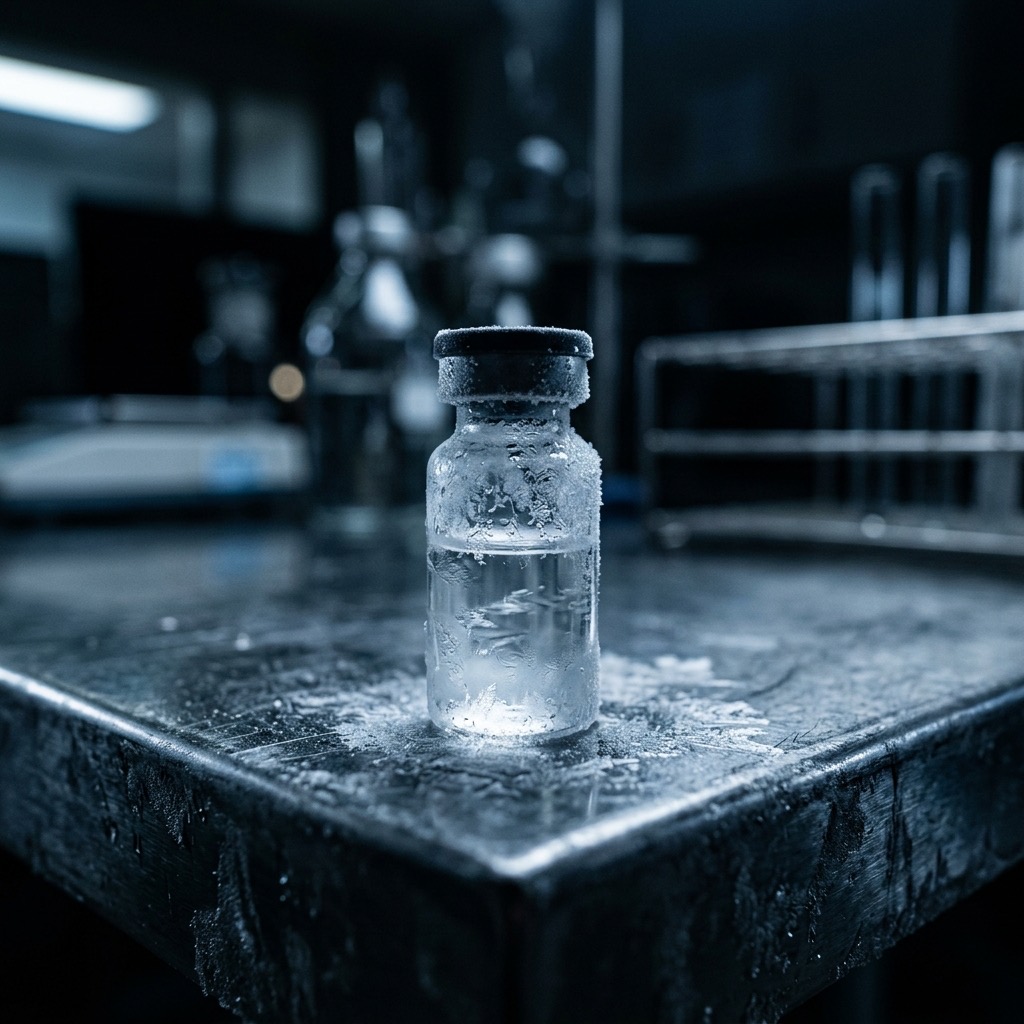
Sometimes, fridges run too cold, and you pull out a vial only to find a slushy or solid block of ice inside. What should you do?
Let it thaw naturally in the refrigerator. Do not heat it up or run it under warm water. Once it is fully thawed, inspect it. If the liquid is cloudy or has particles floating in it, the peptide is destroyed and should be discarded. Even if it appears clear, you should assume a significant loss in potency. It is generally safer and more effective to start fresh with a new vial.
Conclusion
While the freezer is your best friend for hoarding unmixed peptide powder, it is the absolute enemy of your reconstituted vials. Stick to the fridge, keep them out of the light, and your mixed peptides will comfortably last the typical 28 to 30 days needed to finish a cycle.