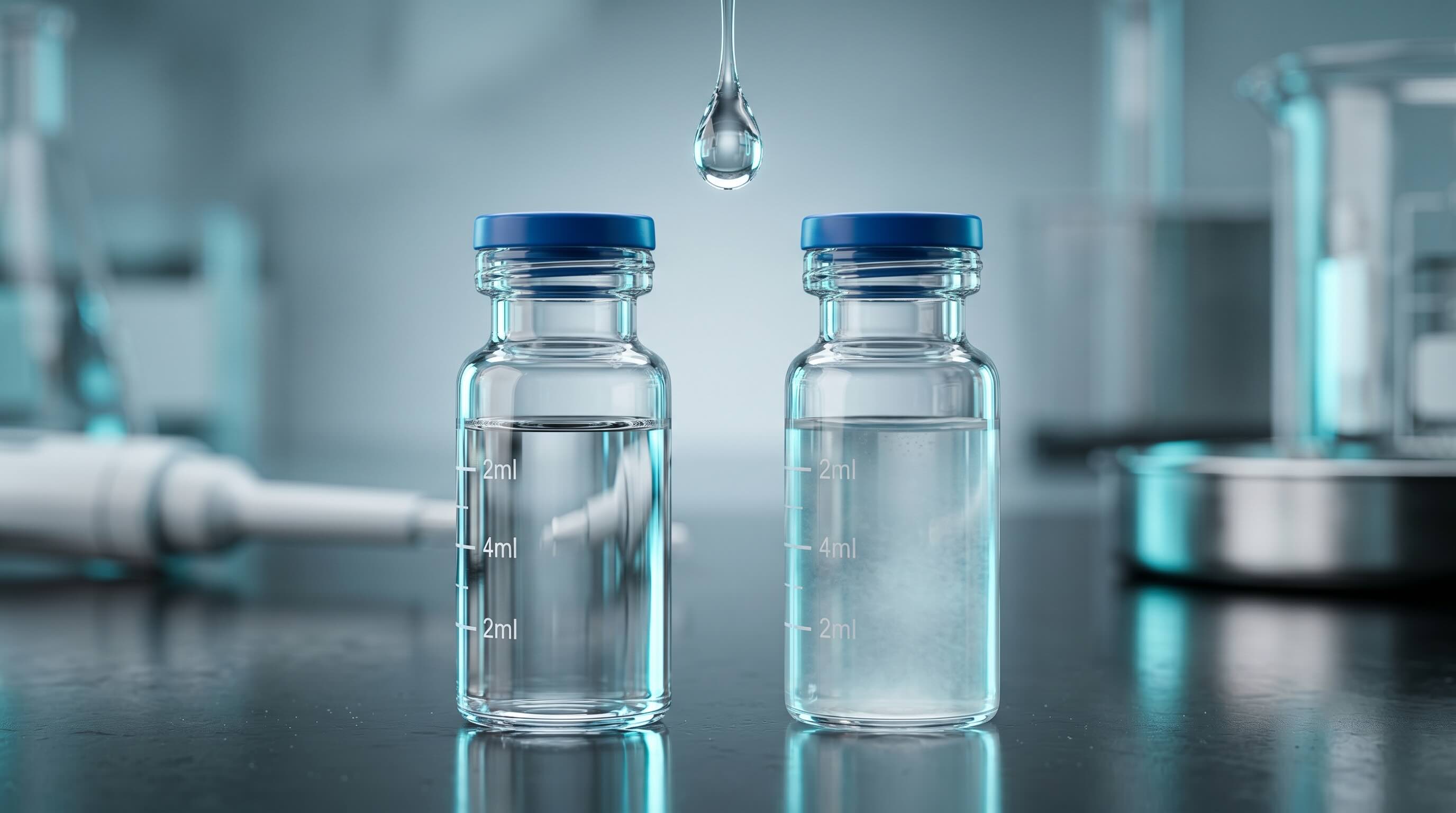
Introduction: The Reconstitution Bottleneck
Operating purely in a dry, lyophilized vacuum state, synthetic peptides are remarkably stable, capable of persisting for years under sub-zero thermal lock without structural decay. However, the exact moment a solvent is introduced to dissolve the crystalline puck, the biological timer starts ticking.
The debate between Bacteriostatic Water vs Sterile Water is not a matter of aesthetic laboratory preference; it is a rigid matter of molecular chemistry. Utilizing the incorrect solvent matrix violently destabilizes delicate peptide carbon bonds, rendering the clinical asset useless within hours. This foundational guide anchors the biological justification for the volumetric matrices mapped throughout our Peptide Dosage Calculators.
Section 1: The Core Distinction
To extract actionable insights from clinical models, researchers must distinguish the definitive properties of the two primary biological solvents.
- Sterile Water for Injection (SWFI)A pure solution that has been rigorously sterilized to eliminate all microbiological contaminants. However, it contains absolutely zero preservatives. Once the vial's airtight seal is breached, SWFI immediately becomes a hyper-fertile breeding ground for airborne bacteria. Peptides reconstituted in SWFI must be completely consumed within 24 to 48 hours, or they risk septic contamination.
- Bacteriostatic Water (BAC)SWFI structurally enhanced with precisely . The alcohol acts as an extreme bacteriostatic agent, halting the mechanical reproduction of bacteria within the solution. This allows the newly hydrated peptide matrix to safely survive multiple needle extractions over a prolonged 28-day cyclic window.
Section 2: pH Buffering and "Aqueous Aggregation"
The role of Benzyl Alcohol extends far beyond basic sterility; it actively serves as an osmotic stabilizer.
Complex, long-chain analog structures (like Semaglutide or Retatrutide) are extraordinarily susceptible to slight environmental shifts. If the biological solution experiences rapid internal pH fluctuations, the electrostatic charge holding the amino acids in their precise helical shapes collapses.
The Mechanics of Aqueous Aggregation
When a peptide loses its biological shape due to unbuffered solvent shock, the molecules begin sticking to one another rather than remaining freely dispersed. This forms a cloudy, irreversible microscopic web known as Aqueous Aggregation.
The inclusion of the Benzyl Alcohol in Bacteriostatic water establishes a rigid protective buffer, anchoring the solution's pH range firmly between 4.5 and 7.0. This electrochemical "straightjacket" prevents the hydrophobic collapse, maintaining crystalline clarity and preserving the peptide's targeted receptor affinity for nearly a month.
Visual Check
Personal Lab Note: "If your solution displays even a trace of 'floaters' or a silk-like swirl upon agitation, aggregation has begun; the vial should be disposed of."
Section 3: Standard Operating Procedure (The 28-Day Rule)
Despite the supreme chemical shielding provided by Bacteriostatic Water, clinical protocol dictates that no reconstituted multi-dose vial should remain in active service beyond 28 days.
As repeated spatial Extractions () occur, minuscule pockets of ambient air are forcefully injected back into the vial to equalize the vacuum pressure. This compounding oxygen exposure generates a slow, steady rate of oxidative stress against the alcohol suspension. Around day 28, the benzyl alcohol's efficacy rapidly depreciates, crossing an absolute mathematical threshold where bacterial suppression is no longer guaranteed.
Cryogenic vs. Refrigerated Handling
- Pre-Reconstitution (Dry): Store tightly sealed inside a dark deep-freeze. Stable for 24-36 months.
- Post-Reconstitution (Wet): Must immediately transition to a standard medical refrigerator. Never refreeze the compound after mixing. The formation of ice crystals inside liquid bacteriostatic water operates like microscopic scissors, physically shredding the protein linkages upon thawing.
Integrating the Science
When calibrating any dosage vector—whether establishing high-density steady states for Tesamorelin or mitigating PIP in Copper Peptides—employing Bacteriostatic Water over Sterile Water is an absolute, non-negotiable prerequisite. To intelligently log reconstitution dates and actively monitor your exact 28-day benzyl-alcohol expiration horizons, we mandate the utilization of our Peptide Protocol Planner.